African roots, a Souiri brotherhood
The Gnawa descend from men and women from sub-Saharan Africa, many of them brought to Morocco as slaves from the 16th century onwards, notably after the Saadian sultan Ahmad al-Mansur's campaigns against the Songhai Empire. Over generations their practices blended with Islam and with Morocco's Amazigh cultures. UNESCO, which inscribed Gnawa on its Representative List of the Intangible Cultural Heritage of Humanity in December 2019, describes it as a possession-healing ritual of all-night rhythm and trance, and notes its ties to the history of slavery in North Africa.
The Gnawa regard Sidna Bilal, a freed slave who became Islam's first muezzin, as their spiritual ancestor. His name is carried by the Zaouia Sidna Bilal, at the foot of the ramparts in the Bani Antar quarter. This 18th-century sanctuary, restored in the 2000s by the Dar Gnaoui association, is the house of Essaouira's brotherhood, one of the oldest in the country: the repertoire is passed on here, followers are welcomed and lilas are held.
The lila, a night of music and healing
At the heart of the practice is the lila (“night”), a ceremony in which musicians summon the spirits, or mlouk, to soothe a patient or fulfil a vow. The full ritual, the derdeba, follows codes known in detail only to initiates. It often opens with a street procession to the beat of large drums (tbel), then moves indoors until dawn.
The maâlem, or master, sings and plays the guembri, a three-string bass lute with a wooden body covered in skin. Around him, musicians clatter the qraqeb, heavy iron castanets with a hypnotic rattle, and answer in chorus. The moqaddema, the brotherhood's female figure, prepares the incense and fabrics and watches over the night.
The colours of the spirits
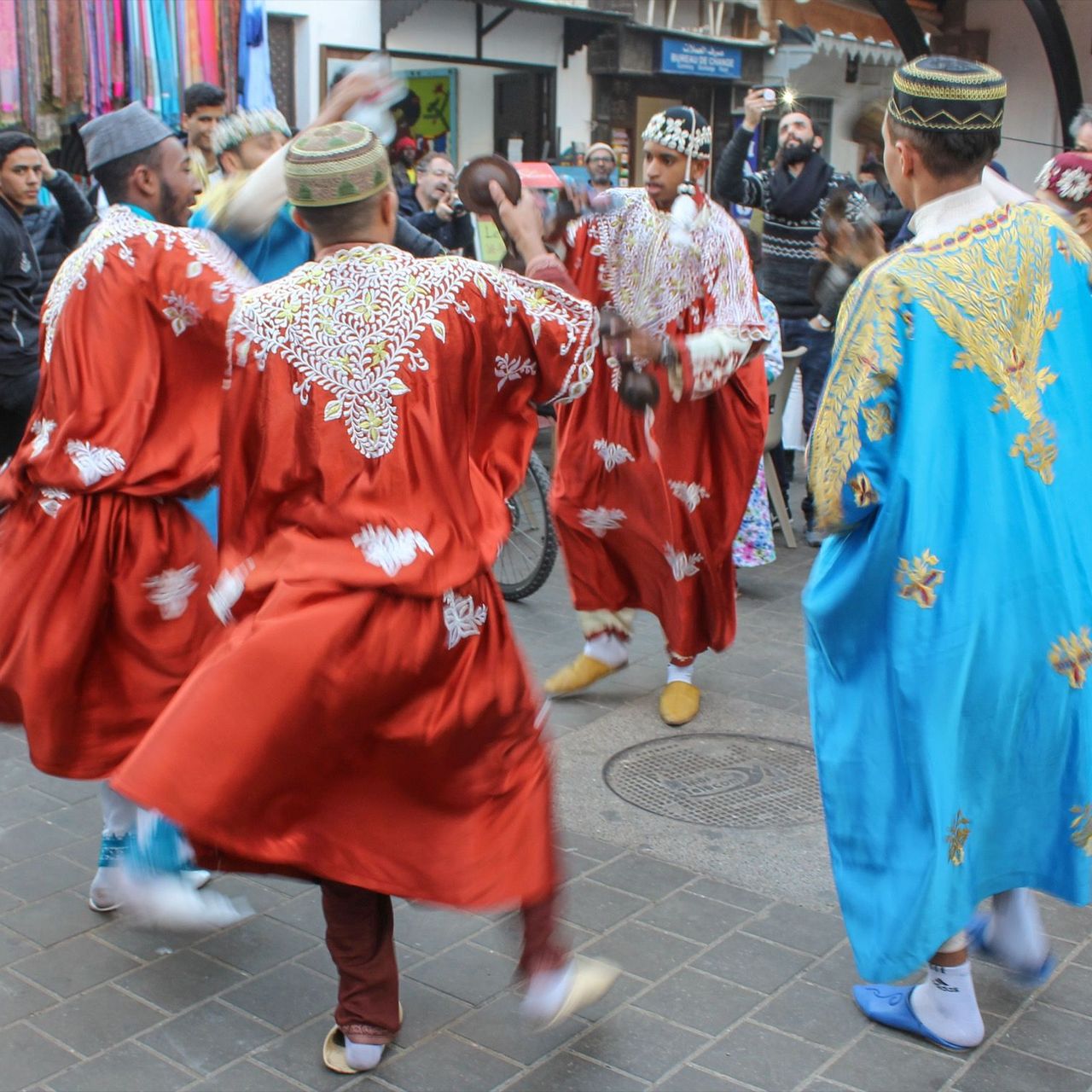
Each family of spirits has its own colour, incense, songs and dance. Interpretations vary, but the broad lines are shared:
- White (sometimes green): the chorfa spirits, linked to the Prophet and the saints;
- Light blue: spirits of the sea and sky, known as moussaouiyine;
- Black: spirits of the forest and of darkness;
- Red: spirits linked to blood, childbirth and circumcision;
- Yellow: the female figure of Lalla Mira.
On stage, these colours reappear in the troupes' costumes, a nod, for those in the know, to the spirit the maâlem has chosen to honour.
Mahmoud Guinia, master of the guembri
No name embodies Essaouira's Gnawa tradition better than that of the Guinia family. Born in the city in 1951, Mahmoud Guinia was the son of maâlem Boubker Guinia and of a moqaddema, A'isha Qabral. He learned the guembri as a child, was among the first to open the lila to outsiders and drew from the instrument a deep, powerful sound that earned him the nickname “the Jimi Hendrix of the guembri”.
His recordings show how far he travelled: The Trance of Seven Colors (1994) with saxophonist Pharoah Sanders, co-produced by Bill Laswell, and The Wels Concert, recorded in 1996 with Peter Brötzmann and Hamid Drake. In spring 2015, already ill, he handed his guembri to his youngest son Houssam at a concert the town still talks about. He died in the city on 2 August 2015. His brothers Mokhtar and Abdellah, his sister Zaida, a moqaddema, and now Houssam carry the lineage on.
The Gnaoua World Music Festival in Essaouira
Launched in the late 1990s, the Gnaoua World Music Festival brought the maâlems out of closed circles and into conversation with jazz, blues and music from across Africa and beyond. Every June the medina changes pace: large free stages on Place Moulay Hassan and the beach, intimate ticketed concerts in zaouias and heritage venues, and one-off fusions between Gnawa masters and international guests.
The 27th edition ran from 25 to 27 June 2026. According to the organisers, as reported by the Moroccan press, it brought together some 460 artists, including 43 maâlems, for around fifty concerts and more than 300,000 festivalgoers. Dates for the next edition are usually announced in spring, and the town fills up fast, so book your stay early (see our pick of hotels).
Where to hear Gnawa music year-round
The festival is only one window. The rest of the year, Gnawa music is a quieter affair and takes a little patience to find:
- Zaouia Sidna Bilal remains the reference. Lilas are private, but some open to the public during the festival or on brotherhood feast days. Traditionally they multiply during the month of Shaaban, just before Ramadan.
- Medina rooftops and restaurants regularly book Gnawa musicians, especially at weekends and in high season. On the roof terrace of KSOU, on Avenue du Caire, a Gnawa concert is billed every evening at 9.30pm. Line-ups change often, so ask locally.
- Cultural venues such as Dar Souiri, home of the Essaouira-Mogador association, host occasional concerts and talks.
- The street: in the late afternoon you will often come across musicians around Place Moulay Hassan or near the ramparts.
For further reading, Viviana Pâques (La Religion des esclaves) and Abdelhafid Chlyeh (Les Gnaoua du Maroc) remain the classic studies. See also our other arts and culture stories.
Practical information
- Festival: held in June over three or four days. Main stages are free; zaouia and small-venue concerts require separate tickets.
- Lilas: attendance is by invitation. Be discreet and never take photos without permission.
- Listen: The Trance of Seven Colors by Mahmoud Guinia and Pharoah Sanders is a good way in.