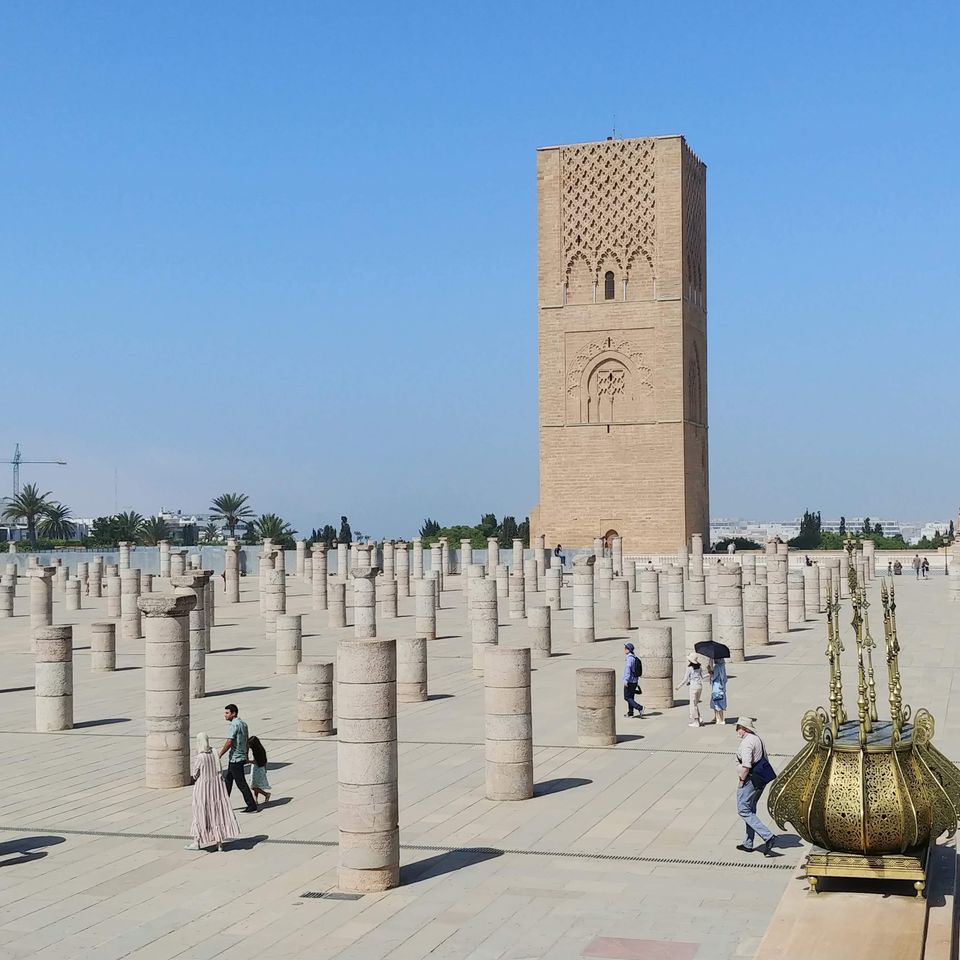
Set on an esplanade above the mouth of the Bouregreg river, Hassan Tower is the minaret of a vast mosque begun in 1196 by the Almohad caliph Yacoub El Mansour and never completed. Surrounded by a grid of columns and facing the Mausoleum of Mohammed V, it is Rabat’s defining landmark.
A building site frozen in time
In 1196 the Almohad caliph Yacoub El Mansour began work in Rabat on what was meant to be one of the largest mosques in the Islamic world. Construction stopped when he died in 1199, and the 1755 earthquake brought down much of what had been built. Today only the minaret, sections of wall and column shafts remain. Nobody knows for certain where the name “Hassan” comes from.
Hassan Tower’s architecture
- Red sandstone minaret standing 44.3 m tall, against more than 60 m planned
- Four carved façades, each with its own pattern of arches and interlacing
- Inside, ramps instead of stairs, designed so that the top could be reached on horseback
- Nearly 200 columns, whole or broken, still trace the outline of the prayer hall
The esplanade
The tower faces the Mausoleum of Mohammed V, built in the 1960s at the far end of the esplanade. It was here, back from exile, that Mohammed V announced Morocco’s independence at Friday prayers. Below the site, on the same axis, stands Zaha Hadid’s Royal Theatre of Rabat. The whole area belongs to the UNESCO World Heritage property “Rabat, Modern Capital and Historic City”, listed in 2012.
Practical information
- Open daily, 9am to 6pm
- Entrance from Boulevard Mohamed Lyazidi, in the Hassan district
- Open-air site with little shade: go early or late in the day
- Dress modestly, as this is both a religious and a memorial site
- Combine with the neighbouring mausoleum and, further on, the Kasbah of the Udayas