Sbagha Bagha, the festival that opened up the walls
It began in September 2013, alongside the L’Boulevard music festival. Its founders launched "Sbagha Bagha" with a simple idea, summed up at the time by co-founder Hicham Bahou: to answer the billboards smothering the city’s façades with artworks, and to give Casablancans’ eyes "what they deserve". The first walls were painted by Moroccan and Spanish graffiti artists on Avenue des FAR and in the old medina.
Run by the EAC-L’Boulvart association, Sbagha Bagha went on to become a festival in its own right, with muralists invited from around the world, a graffiti battle for young Moroccan talent and workshops for children. The fifth edition, in 2018, took wildlife as its theme. Belgian artist ROA painted a black-and-white tortoise, snake and chameleon in the Bourgogne district; Mexico’s Werc an enigmatic rabbit-man-panther at the seaward end of Boulevard Zerktouni; Canada’s Danaé a dreamlike creature on Rue de l’Alma; and Casablanca’s own Ed Oner, on his first large solo wall, two children captivated by a seller of animal masks near the Hassan II Mosque. The Skefkef comics collective painted a giant comic strip on a wall in the old medina. The sixth edition ran from 2 to 18 July 2019.
Casamouja and the façades of El Hank
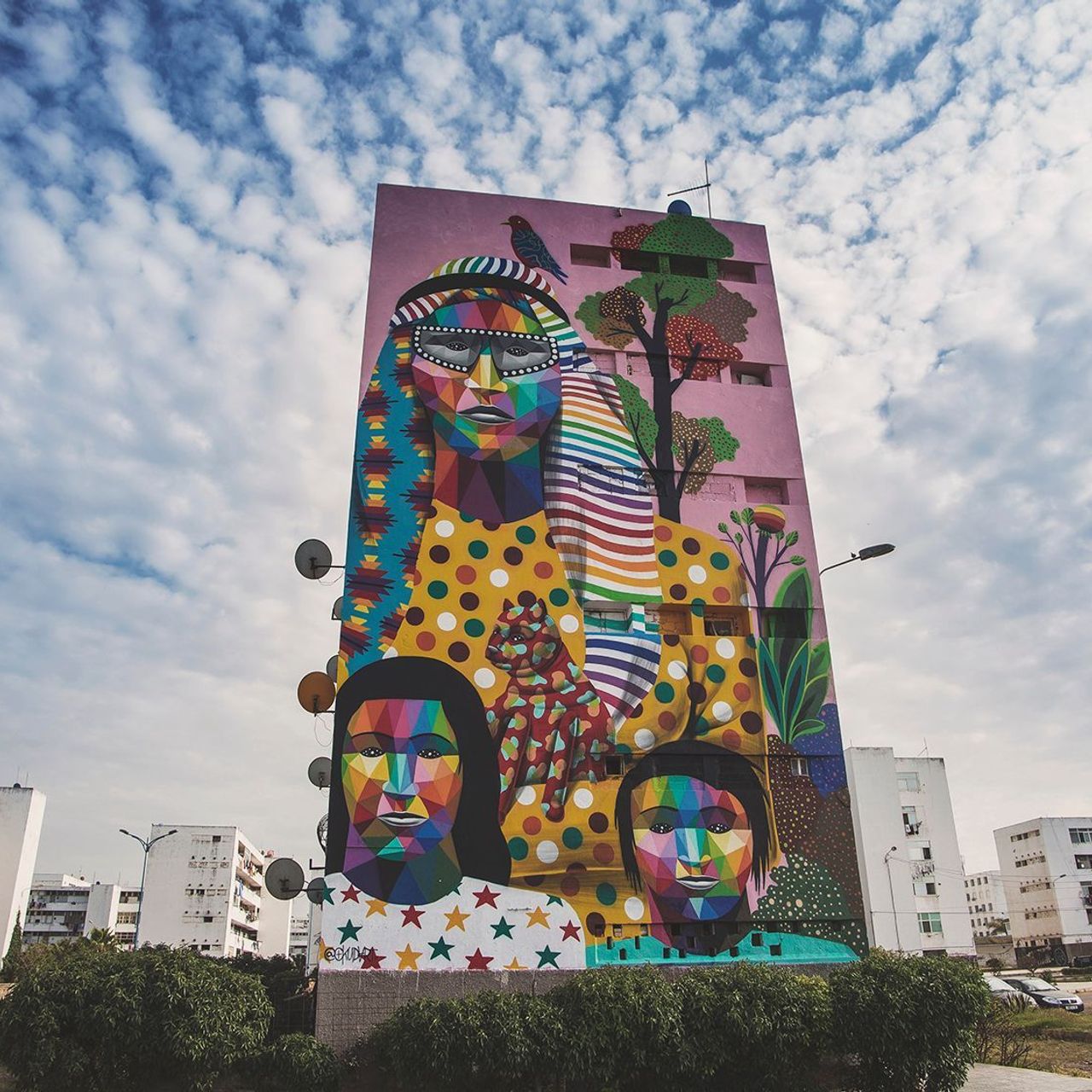
Meanwhile the city launched its own mural programme, Casamouja, organised by Casablanca Events et Animation under the WeCasablanca banner. In 2018 its third edition turned the El Hank district, near the lighthouse, into an open-air gallery: nine murals celebrating women, by seven artists including Spain’s Okuda, American Sam Kirk and Moroccans Majid El Bahar, Iramo, Dynam and Amin Brush. Okuda painted Mother Power, a geometric, multicoloured tribute to mothers; Sam Kirk twin sisters with windswept hair facing the ocean; Iramo a smiling mother carrying her child on her back; Dynam a portrait of Ingrid Bergman, Ilsa in the film Casablanca.
The programme has carried on year after year. Its ninth edition, in 2024, added ten murals on the theme of civic values (citizenship, solidarity, tolerance), taking the total to more than 90 walls across every district of the city since it began. Artists included Majid El Bahar, with a lighthouse on a cliff, Amin Brush, Kato with swallows woven into patterns from the Hassan II Mosque, as well as Sika and Dais.
Where to see the murals
El Hank and the Corniche
This is the most striking route: buildings painted from pavement to roof, a few minutes’ walk from the El Hank lighthouse, with the minaret of the Hassan II Mosque as a backdrop. Several walls in the area also pay tribute to Morocco’s national football team, with portraits of Achraf Hakimi, Yassine Bounou and coach Walid Regragui.
Bourgogne and Boulevard Zerktouni
The Bourgogne district and the seaward end of Boulevard Zerktouni hold many of the Sbagha Bagha works. Further east, on Boulevard Roudani, the façade of the headquarters of Alsa, the city’s bus operator, serves as a free-expression wall where graffiti artists regularly paint over earlier pieces.
The old medina and the mosque esplanade
Sbagha Bagha’s first playground in 2013, the old medina hosted Skefkef’s giant comic strip. On the seafront esplanade of the Hassan II Mosque, a mural by Amin Brush accompanies the walk towards the ocean.
Artists to follow
Casablanca’s scene has grown around a handful of names. Ed Oner, one of the pioneers of Moroccan graffiti, has spent years exploring new graphic worlds. Majid El Bahar, from the Beni Mellal region, champions a "folklorism" drawn from popular motifs and plays with the way we look. Iramo and Dynam often work as a duo, somewhere between realist portraiture and dreamscape. Amin Brush, real name Amine Hajila, moves from one large façade to the next. The Skefkef artists bridge comics and street art. Their work continues in studios and galleries: our Arts & Culture section lists the city’s exhibition spaces. In Rabat, the Jidar festival, directed by Salah Malouli, Sbagha Bagha’s former artistic director, celebrated its tenth anniversary in 2025.
Exploring on foot or by bike
The Alouane Bladi association regularly runs bike tours of around three hours, covering a dozen kilometres, to discover the murals with the artists themselves, sometimes in partnership with the Institut français. Guided tours are also listed on the usual booking platforms. On foot, El Hank takes about an hour; it combines well with a visit to the Hassan II Mosque and a break by the ocean.
Bear in mind that a mural is not forever: sun, sea spray, renovations and new commissions change the landscape from one year to the next. That is part of the appeal.
Practical information
- Where to start: El Hank, around the lighthouse, then along the Corniche towards the Hassan II Mosque.
- When: morning, for the light and the cooler air; large walls are best photographed from the opposite pavement.
- Guided tours: Alouane Bladi (by bike, dates announced on its social media) and tours on booking platforms.
- Combine with: the Hassan II Mosque and the Art Deco city centre.