Casablanca, a 20th-century architecture laboratory
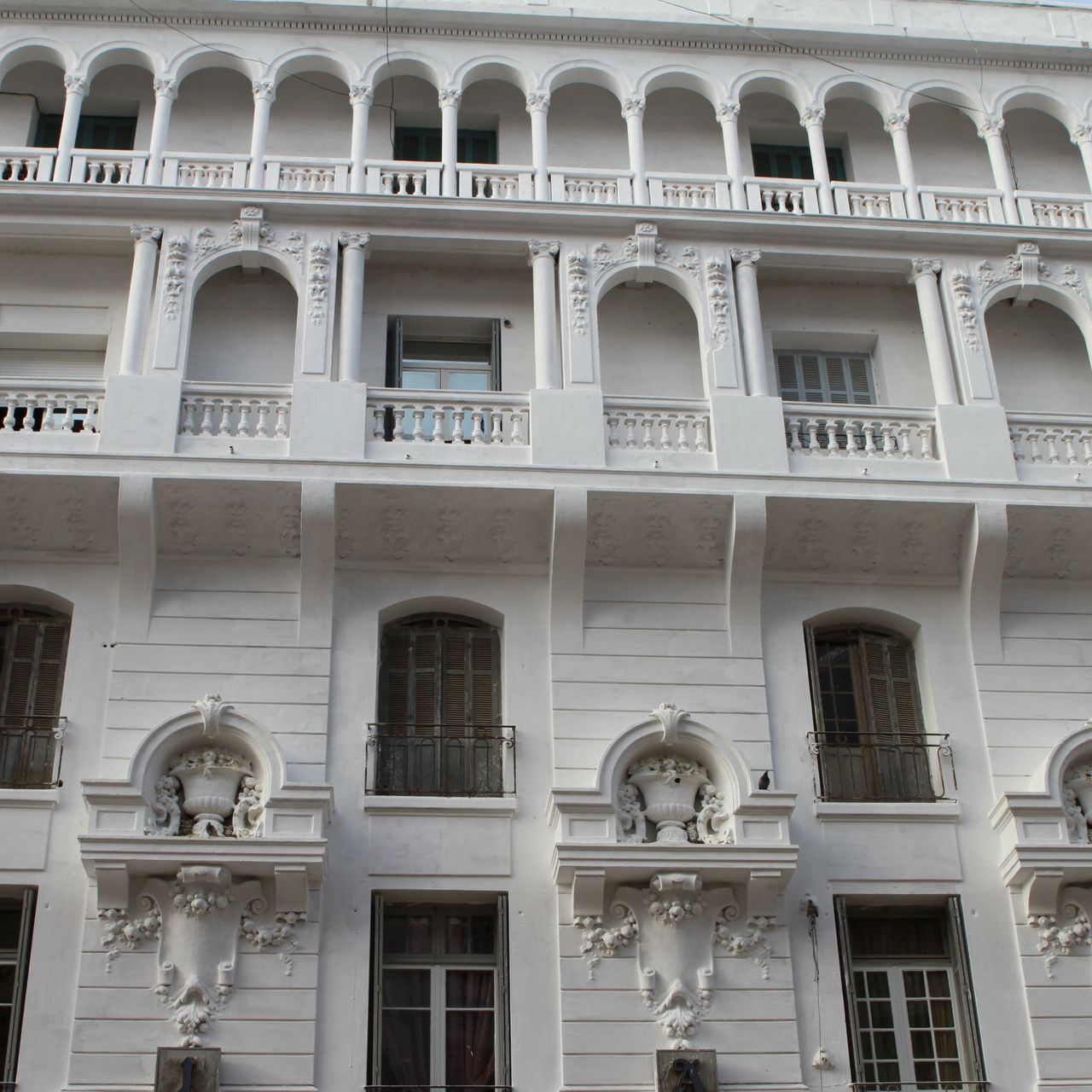
Casablanca has neither the ancient ramparts of Fez nor the palaces of Marrakech. Its heritage lies elsewhere: in the white facades, wrought-iron balconies and grand lobbies of buildings put up between the 1910s and the 1960s. From 1912, under the French protectorate, Resident-General Lyautey chose to leave the old medina intact and build a new city beside it. Urban planner Henri Prost drew the first extensions between 1917 and 1922, and a generation of architects – Hippolyte Delaporte, Marius Boyer, Edmond Brion, Pierre Jabin and later Jean-François Zevaco – turned the city into a testing ground on a metropolitan scale.
Reinforced concrete, then a cutting-edge material, made new shapes possible: rounded corners, continuous balconies, corner towers. In January 2024, 56 twentieth-century buildings were listed as historic monuments, a sign that this long-neglected heritage is finally being recognised.
From Neo-Moorish to Art Deco and modernism
The first buildings outside the medina were Neo-Moorish: arches, glazed green tiles, ceramic panels and canopies, in the spirit of what was being built in Algiers and Tunis at the time. Then came neoclassical facades heavy with garlands, masks and ornate balconies. From the 1920s, Art Deco took over: strict geometry, symmetry and stylised ironwork, which architects combined with the zellige tilework, stucco and carved wood of Moroccan craftsmen. After the Second World War, the city moved on to modernism, ocean-liner apartment blocks and a rawer kind of architecture.
Five buildings to know
Hôtel Excelsior
Facing the old medina on Place des Nations Unies, the Hôtel Excelsior was built between 1914 and 1916 by Hippolyte Delaporte. One of the first major hotels outside the city walls, it is a textbook example of Casablanca's Neo-Moorish style, with arcades and ceramic tiles. Its brasserie was for years the meeting place of European traders passing through. The building is part of the city's protected heritage.
Cinéma Rialto
Completed around 1929-1930 to designs by Pierre Jabin, the Rialto seats 1,350 beneath a dome. Cinema, music hall and concert venue, it recalls the golden age of Casablanca's picture palaces, most of which have since disappeared. Its facade with red lettering is one of the most photographed sights downtown.
Immeuble Liberté
Nicknamed "17 étages" (17 floors), the Liberté building was built between 1949 and 1951 by Léonard Morandi. At around 78 metres, it was one of Africa's first skyscrapers. Its ship's-prow silhouette overlooks the square now named after Jacques Lemaigre-Dubreuil, a newspaper owner who supported Moroccan independence and was shot dead at the foot of the building on 11 June 1955.
Villa Zevaco
On the edge of Anfa and Maârif, Villa Suissa, better known as Villa Zevaco or the "Pagoda villa", was completed in the late 1940s by Casablanca-born Jean-François Zevaco (1916) with Paolo Messina, for property developer Sami Suissa. With its sculptural roof, bold volumes and wide windows, it is often wrongly labelled Art Deco but is really a piece of post-war modernism. Left empty for years, it was restored in the early 2000s and now houses a Paul bakery and tea room, so you can see the interior over a coffee.
Hôtel Lincoln
On Boulevard Mohammed V, the Hôtel Lincoln, designed by Hubert Bride in 1916-1917, long symbolised heritage at risk: partial collapses, a listed facade and endless legal battles. Reconstruction began in the early 2020s and the property changed hands in 2025. Its opening, postponed several times, has yet to be confirmed.
Boulevard Mohammed V and Place Mohammed V
Formerly Boulevard de la Gare, Boulevard Mohammed V is lined with arcaded buildings, shopping passages and Art Deco facades, and is now served by the tram. It is also home to the Central Market, designed by Pierre Bousquet and inaugurated in 1919, whose renovation got under way in 2026.
Further south, Place Mohammed V, the former administrative square laid out by Henri Prost and Joseph Marrast, gathers the main public buildings: Marrast's law courts (early 1920s), Adrien Laforgue's main post office (1918-1920), Marius Boyer's former town hall, now the Wilaya, completed in 1937 with its clock tower, and Edmond Brion's Bank Al-Maghrib. All blend Art Deco with Moroccan features such as arcades, zellige and green tiles.
A few minutes away, the former Sacré-Cœur Cathedral by Paul Tournon, built in white concrete from 1930 onwards, reopened in November 2023 after a lengthy restoration and now hosts exhibitions and events.
Casamémoire, the city's heritage watchdog
Founded in 1995, the Casamémoire association has been instrumental in getting this heritage recognised. Every spring it runs the Heritage Days – the 15th edition took place from 13 to 19 April 2026 under the theme "Casablanca Atlantique" – with free tours led by volunteer guides, as well as heritage night walks during Ramadan. It is a rare chance to step inside lobbies, stairwells and private villas that are normally closed.
A self-guided Art Deco walking tour
- Place des Nations Unies: the Hôtel Excelsior and the Clock Tower at the entrance to the old medina.
- Boulevard Mohammed V: arcaded buildings, passages, the Central Market and the facade of the Hôtel Lincoln. Look up, and step into lobbies where you can.
- The Rialto, a few streets off the boulevard, for its facade.
- Place Mohammed V: law courts, post office, Wilaya and Bank Al-Maghrib.
- Arab League Park and Sacré-Cœur, for a break in the shade.
- Villa Carl Ficke, which reopened in February 2025 as the Casablanca Memory Museum, with a room devoted to the city as a 20th-century architecture laboratory.
- Take a taxi to finish at the Liberté building and Villa Zevaco.
Practical information
- Allow half a day for the downtown walk, ideally in the morning when the light flatters the facades.
- The tram links Place des Nations Unies, Boulevard Mohammed V and Place Mohammed V.
- Casamémoire's Heritage Days take place in spring; the programme is published on the association's website.
- For more ideas, see our Arts & Culture section.