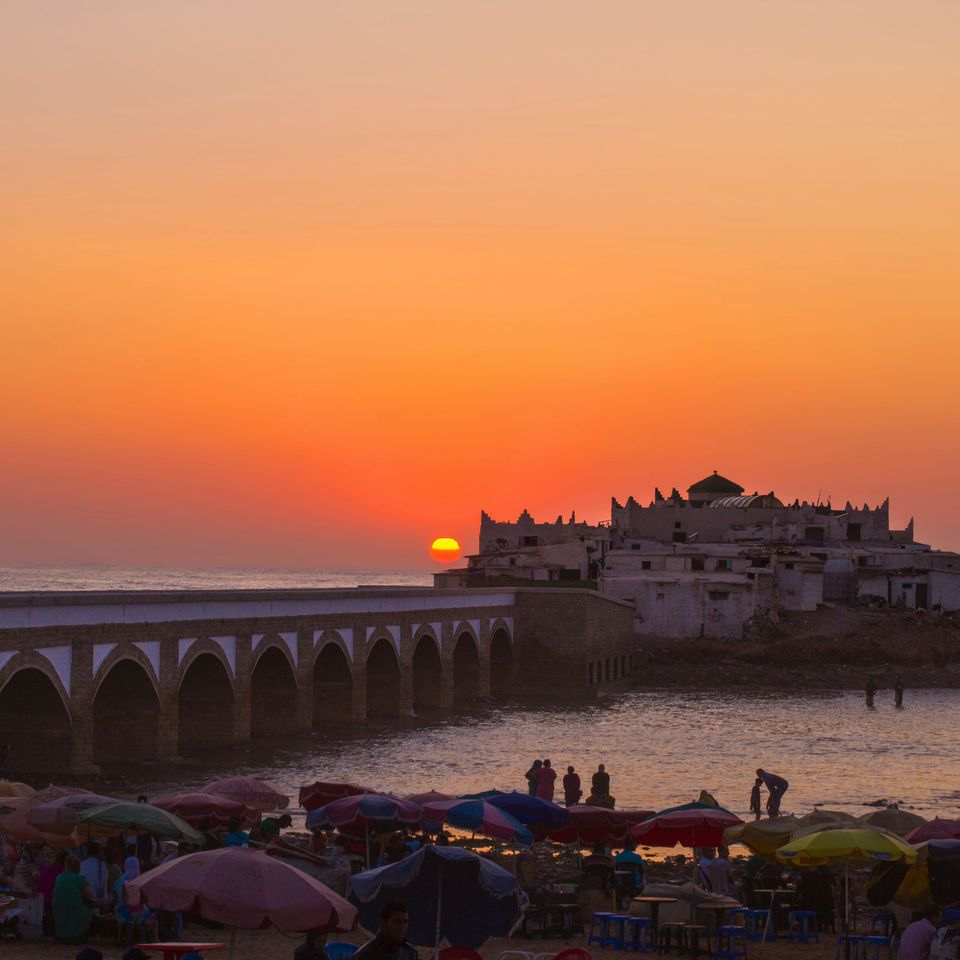
At the western end of the Ain Diab corniche, the islet of Sidi Abderrahmane holds the shrine of a holy man revered since the 19th century. Long crowded with small houses and fortune-tellers, it was cleared in 2024 and reopened to visitors, with an exhibition space and sweeping ocean views.
A holy man from Baghdad
According to tradition, Sidi Abderrahmane came from Baghdad in the 19th century and withdrew to this then-deserted rock at the far western end of today's corniche. Moved by his piety, local people are said to have built him a house; he preferred to sleep under the stars and turned it into a shelter for pilgrims. He died on his island and lies in a white koubba, next to the tomb of his servant.
"The witches' island"
For decades the islet lived like a small village: a single lane lined with whitewashed cottages, sellers of rosewater and incense and, above all, fortune-tellers, which earned it the nickname "the witches' island". Pilgrims and visitors came for a blessing, a cure or advice, in a popular faith that blended devotion to the saint with purification rituals.
A site transformed in 2024
- A bridge linking the islet to the shore was built in 2013; before that, people crossed the rocks on foot at low tide, or rode inner tubes pulled by ropes when the sea came in.
- On 12 January 2024 every building on the islet except the shrine was demolished, and some forty families were rehoused.
- The site was inaugurated as a visitor attraction on 19 September 2024. A new building houses a library, exhibition rooms and panels on the history and legends of the place, and the steps up to the enclosure have been restored. The site is run by the Ministry of Habous and Islamic Affairs.
What to see around the shrine
- The white outline of the shrine on its rocks, at its best in the late afternoon.
- Views over the Atlantic and, to the east, along the Ain Diab corniche.
- The exhibition rooms on the islet's history.
- Nearby, the Sidi Abderrahmane archaeological park, opened in July 2025 in a former quarry: a 2 km trail and an interpretation centre trace Casablanca's prehistory.
Practical information
- Admission was free when the site reopened in September 2024, with opening hours announced as Tuesday to Sunday, 9am to 6pm; check before you go.
- Access also depends on the tide and sea conditions: take care on the rocks.
- This is a place of devotion: dress modestly and keep your voice down near the shrine.
- Reach it by taxi or car along boulevard de l'Océan Atlantique, at the western end of the corniche.