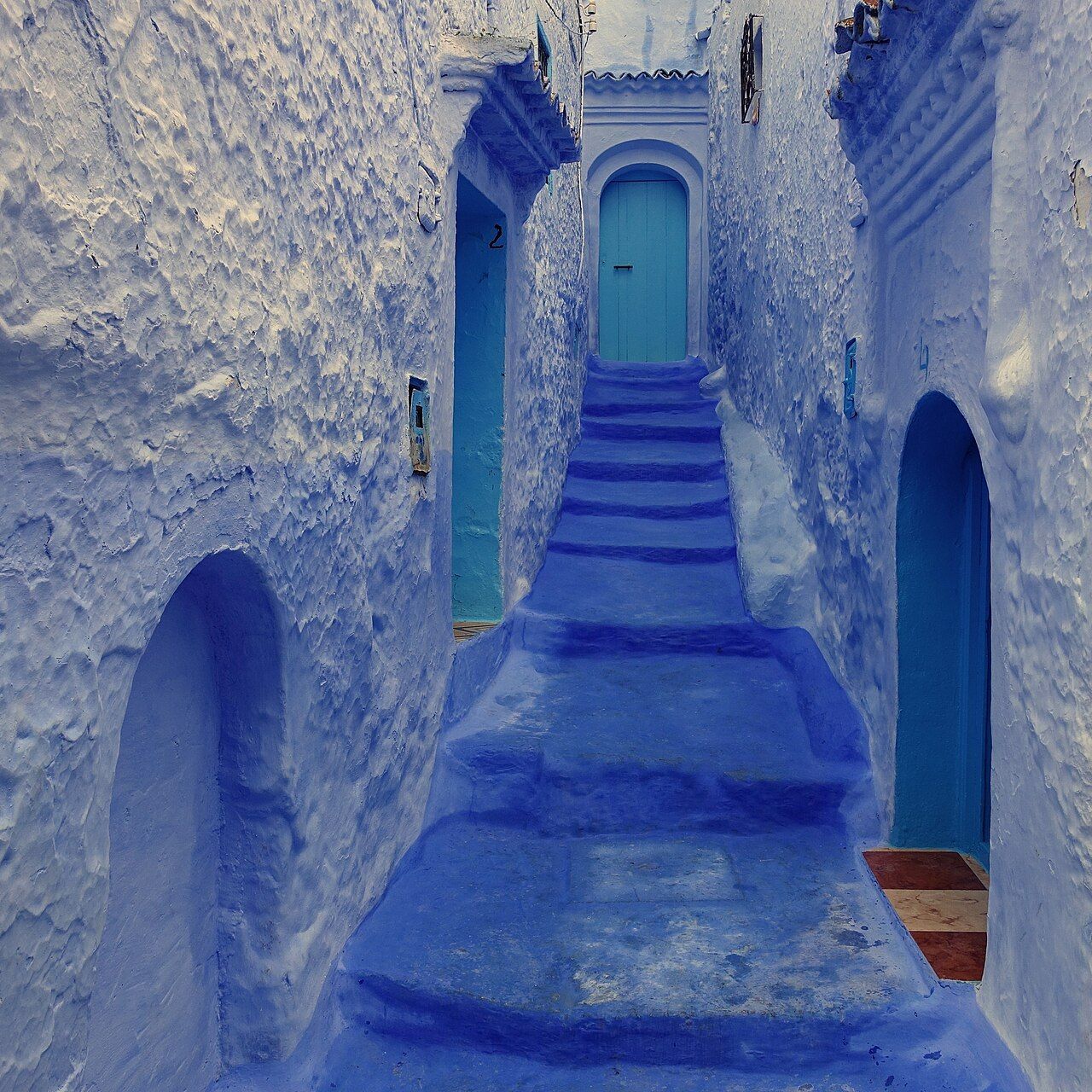
Its blue lanes have become one of the most shared images of Morocco. Behind the postcard, Chefchaouen, "Chaouen" to its residents, is a small mountain town of about 46,000 people tucked beneath two Rif peaks whose shape is said to resemble horns, chef chaouen in Berber. An unusual history explains its isolation, its colour and its charm.
A fortress built to face the Portuguese
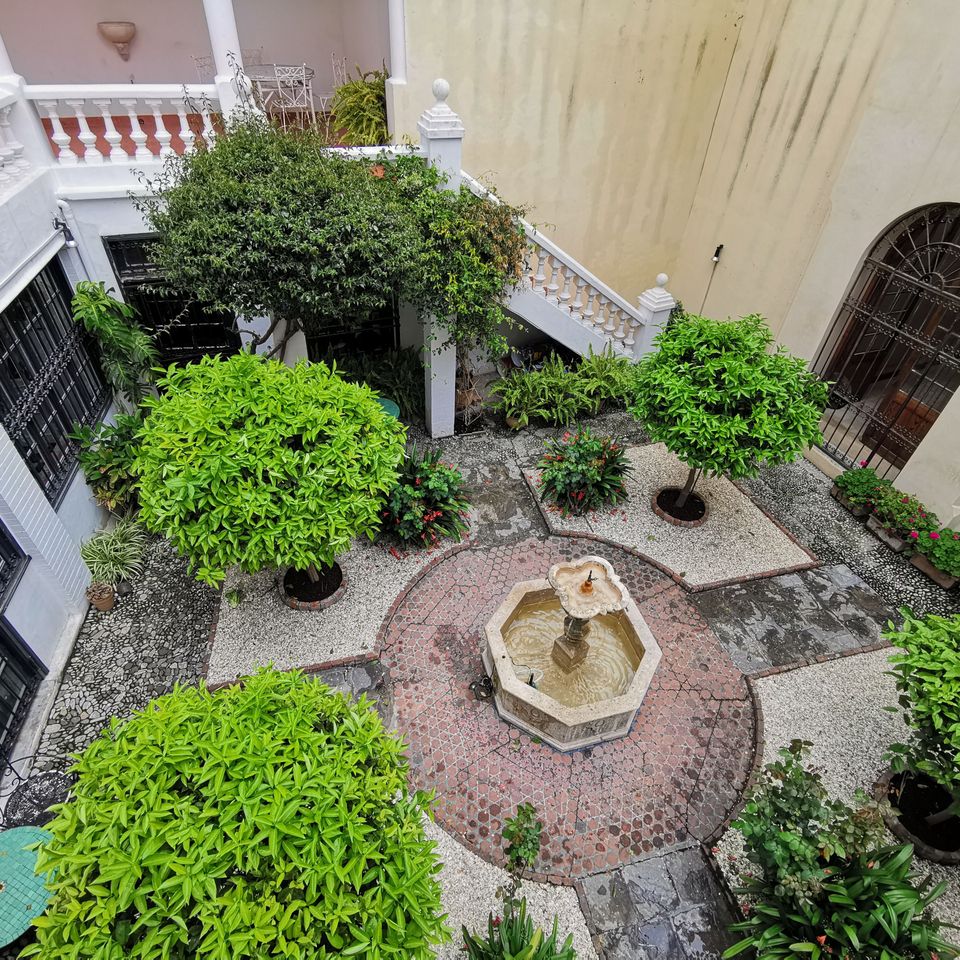
Chefchaouen was born in 1471. That year Moulay Ali ibn Rachid al-Alami built a small kasbah to organise resistance against the Portuguese, in the very year they seized Asilah and Tangier. After the fall of Granada in 1492, Muslims and Jews expelled from Andalusia settled here. On the slopes they built districts of whitewashed houses, tiled roofs and flower-filled patios reminiscent of Andalusia. Further waves of Moriscos followed until the expulsion of 1609.
A holy town turned in on its mountains, Chaouen long remained off limits to Christians. Charles de Foucauld, disguised as a rabbi, was one of the first Europeans to enter and describe it, in 1883. Spanish troops under General Berenguer occupied it in October 1920. The town then fell under the control of Abd el-Krim’s Rif Republic before Spain retook it in 1926, holding it until independence.
Why is Chefchaouen blue?
Every visitor asks, and the answer comes as a set of theories rather than historical certainty.
- The Jewish connection: the most widely cited explanation. The town’s Jewish community, which once made up as much as a third of the population, is said to have painted the houses of the mellah blue, a colour associated with the sky and the divine. Some accounts date the custom to Jewish refugees arriving in the 1930s; others trace it much further back.
- Sky and spirituality: for others, blue evokes the heavens and invites a spiritual life.
- Mosquitoes and coolness: a more prosaic idea holds that blue-tinted lime keeps insects away and houses cool in summer.
- Tourism: according to some residents, blue only spread to the whole medina in the second half of the 20th century, as the town began to attract travellers.
Whatever its origin, the blue has become the town’s signature, to the point that new buildings and some public spaces now adopt it too.
One thing is certain: the colour survives only through upkeep. Every year, before the holidays, residents repaint their façades with lime mixed with pigment, from sky blue to indigo.
Exploring the blue medina
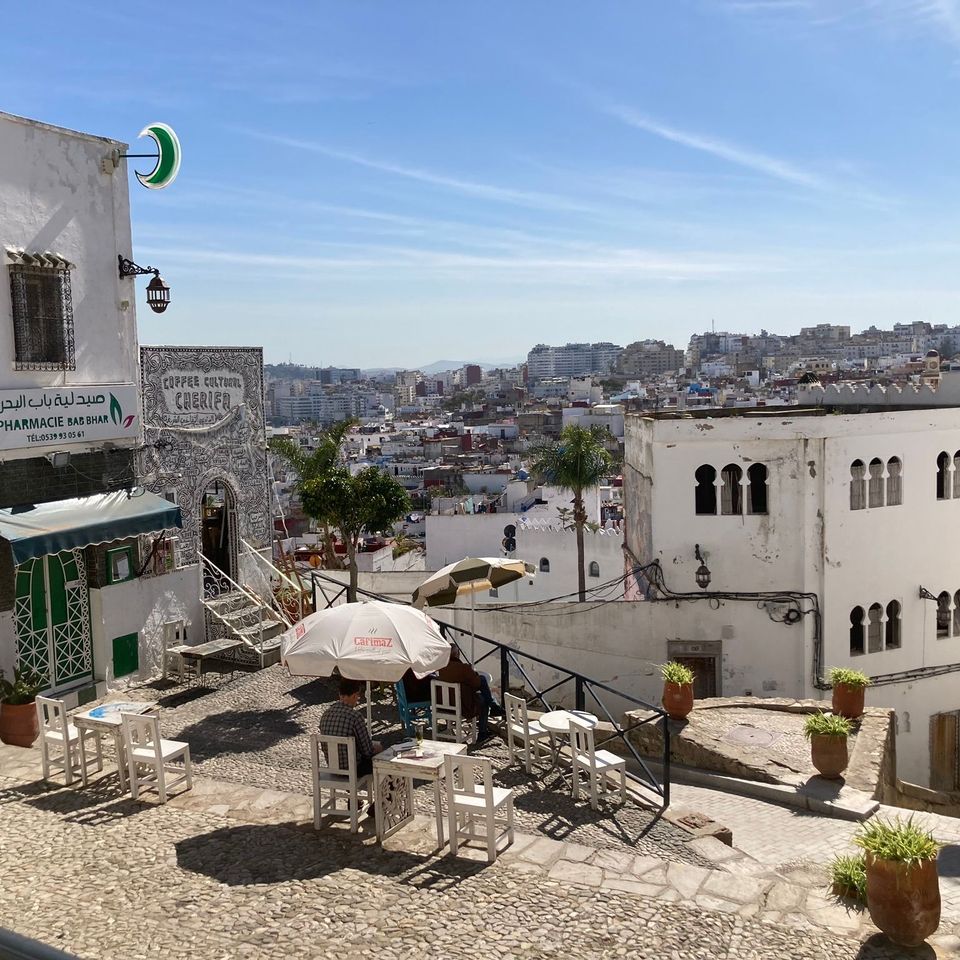
The heart of town is Plaza Outa el-Hammam, lined with cafés. On one side, the kasbah, with its ochre rammed-earth walls and towers, houses a small ethnographic museum and a garden; climb the main tower for a view across the rooftops. On the other, the Great Mosque stands out for its octagonal minaret, a rarity in Morocco.
Then get lost, map-free, in the stepped lanes of the Souika quarter, the oldest, and walk down to Ras el-Ma, the spring that has supplied the town since its founding, where women still wash laundry at the communal basins. At sunset, a twenty-minute path leads up to the Spanish Mosque, built in the 1920s on the hill opposite the medina, for the finest view of the blue city.
Chaouen through the day
In the morning, before the coach tours from Tangier and Fez arrive, the low sun makes the blues glow and the lanes belong to residents: this is the time for photographs. Around midday, the kasbah and its garden offer shade, and the terraces on Plaza Outa el-Hammam serve tagines and soups. The afternoon is for browsing among the weavers and spice sellers of the medina. In the evening, once the coaches have gone, the town slips back into the rhythm of a mountain village, and the call to prayer echoes between the slopes.
Flavours and crafts of the Rif
In 2010 UNESCO named Chefchaouen among the emblematic communities of the Mediterranean diet, inscribed on the Intangible Cultural Heritage list. Try the fresh mountain goat’s cheese, olive oil, honey and local tagines. Stalls sell woollen blankets and djellabas, the pompom-trimmed straw hats worn by Rif women and cedarwood objects.
Hiking in the Rif
Chefchaouen is also the gateway to Talassemtane National Park, nearly 59,000 hectares of limestone mountains and forests home to the Moroccan fir. The most popular outing heads to Akchour, about an hour’s drive away: from there, trails follow the river to waterfalls and to God’s Bridge, a natural rock arch above the gorge. Wear sturdy shoes and avoid flood periods.
Day trip from Tangier: practical information
- Getting there: Chefchaouen lies about 115 km from Tangier, a drive of two to two and a half hours via Tétouan. Buses link the two cities daily.
- How long? A day is enough for the medina, but staying overnight lets you enjoy the lanes early in the morning and in the evening, once the tour groups have left.
- When to go: spring and autumn. Winter is cold and damp in the mountains; summer is very busy.
- Etiquette: the lanes are people’s homes; ask before photographing residents and their doorways.
- More ideas: combine the trip with Tétouan and find more outings under Things to do.