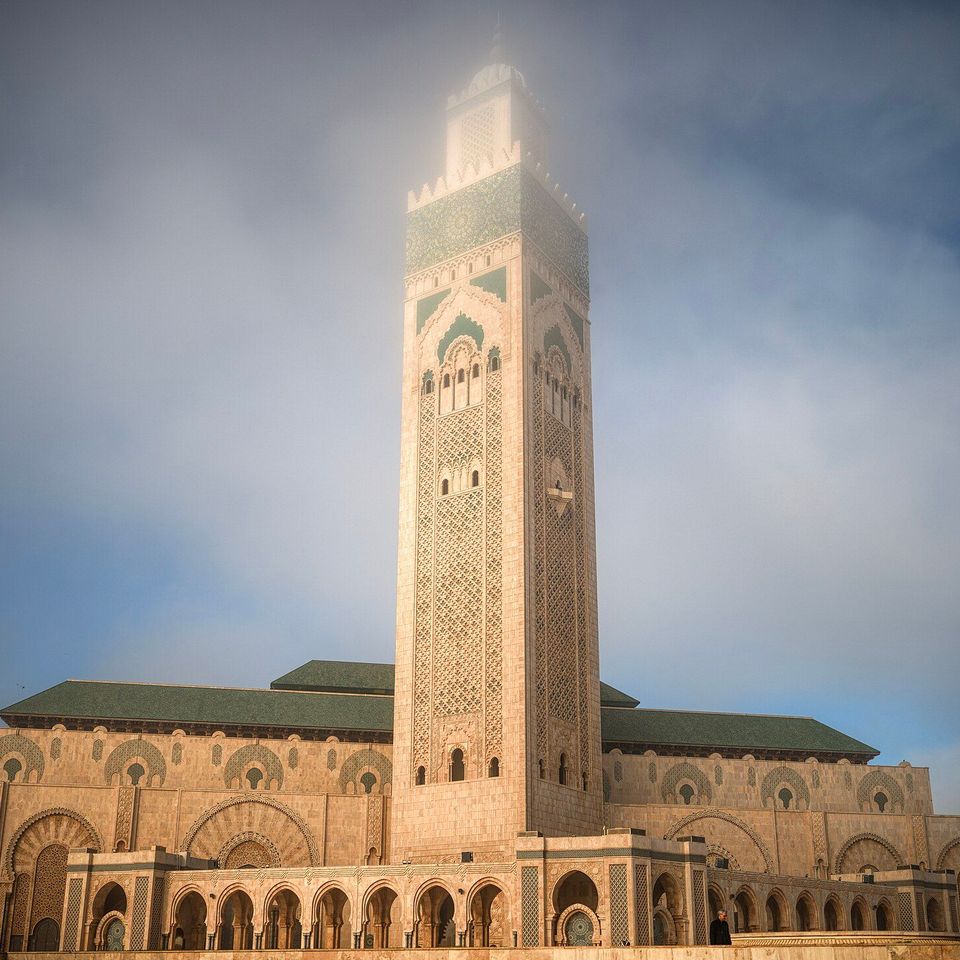
Facing the port and United Nations Square, the old medina is where Casablanca began, rebuilt in the 18th century after the 1755 earthquake. Enter through Bab Marrakech or beneath the Clock Tower to explore ramparts, the Sqala bastion, mosques, a restored synagogue and busy shopping lanes.
Where the city began
Before the Art Deco boulevards and office towers, all of Casablanca fitted inside this medina. It covers about 60 hectares, an irregular polygon roughly 1,000 by 500 metres, once enclosed by ramparts with three main gates: Bab el-Mersa towards the port, Bab es-Souk (or Bab el-Kebir) and Bab Marrakech. After the 1755 earthquake the town was rebuilt by Sultan Mohammed ben Abdallah, who left behind the Sqala bastion and the Ould el-Hamra Mosque.
In the 19th century the medina opened up to international trade, home to consulates, European merchants and Jewish and Muslim communities. Spanish Franciscans built the church of San Buenaventura here in 1890; it is now a cultural centre.
The Clock Tower
On United Nations Square, the Clock Tower marks the entrance to the medina. The 20-metre tower was put up around 1908-1910 on the initiative of Commandant Dessigny, to plans by army engineer Captain Bouillot, in a style borrowed from minarets. It was pulled down in May 1948 and rebuilt in 1993.
What to see
- Bab Marrakech and the ramparts, restored during the rehabilitation programme launched in 2010.
- The Sqala, an 18th-century bastion facing the ocean, now home to the La Sqala café-restaurant.
- The Ould el-Hamra Mosque, the Spanish church of San Buenaventura and the Ettedgui Synagogue, restored and rededicated in 2016.
- The Museum of Photography and Visual Arts, opened in June 2026 on rue Larache in a building by Tadao Ando, run by the National Museums Foundation.
- The shopping lanes around Bab Marrakech: clothes, shoes and hammam supplies, priced for locals rather than tourists.
- Rick's Café, set against the ramparts on boulevard Sour Jdid, for a drink in a setting inspired by the film Casablanca.
Guided tours
Casamémoire's "Old Medina" walk, run during the association's events, links eight stops: the Sqala fortifications, the Spanish church, the Ettedgui Synagogue, the Maison de l'Union, the Ould el-Hamra Mosque, the Marine Gate, the Makhzen and Sidi Bousmara Square.
Practical information
- Free access to the quarter; the Clock Tower is seen from United Nations Square and cannot be visited inside.
- Allow one to two hours, ideally during the day when shops are open.
- Walk in from downtown and United Nations Square, opposite the Hyatt Regency.
- Mosques are open to Muslims only; Casamémoire tours by appointment on +212 5 22 47 43 33.