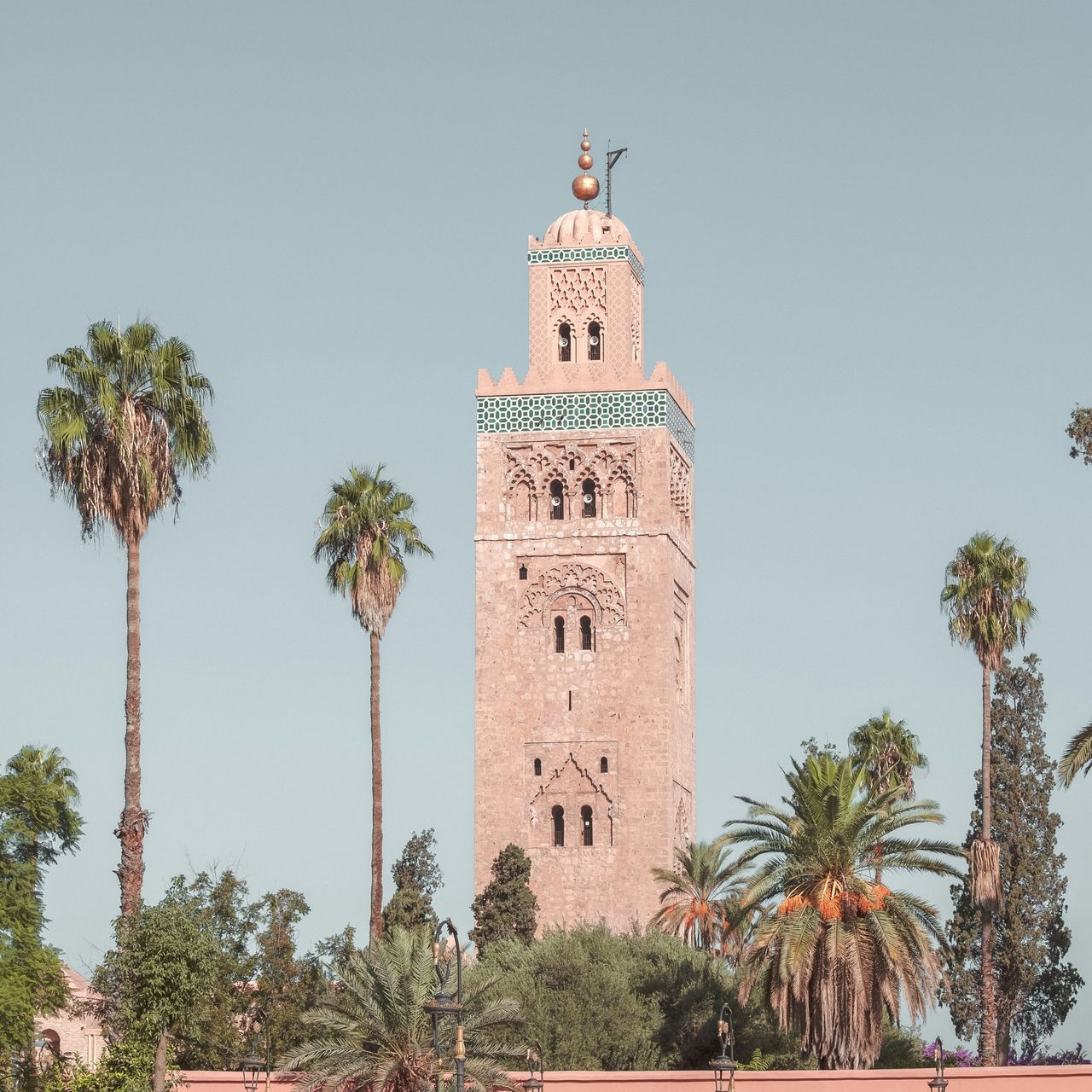
Like a lighthouse guiding sailors, the Koutoubia serves as a geographical landmark that directs lost tourists toward the medina. The name of this religious building comes from the Arabic word “Kitab,” meaning book. This name was given because it was located in the manuscript souk.
Charming by day and luminous at night, the building was established in 1120 under the reign of Abdel Moumen, the first ruler of the Almoravid dynasty. It underwent a redesign in 1162 due to the initiatives of the Almohad emir, Abu Yusuf Yacoub Al-Mansour, who is credited with its final appearance today.
Majestic simplicity
The decor and architecture of the Koutoubia embody the spirit of the Almohad dynasty, which combined austerity and simplicity. Arranged in a T-shape covering an area of 5,300 m², the mosque houses a columned prayer hall and a huge courtyard enclosed by a portico.
Visible from all corners of the city, the splendid 77-meter minaret features three copper spheres - not counting the fourth, which forms the tip - with each representing a holy land of Islam: Mecca, Medina, and Jerusalem. The Koutoubia contains one of the largest prayer halls on the continent with a capacity to accommodate 20,000 people.
More than just a place of worship, the Koutoubia is a historical monument that stands as a testament to the pinnacle of art by the Almoravids and Almohads, akin to the Hassan Tower and the Giralda Mosque in Seville, which was transformed into a cathedral after the city's reconquest.