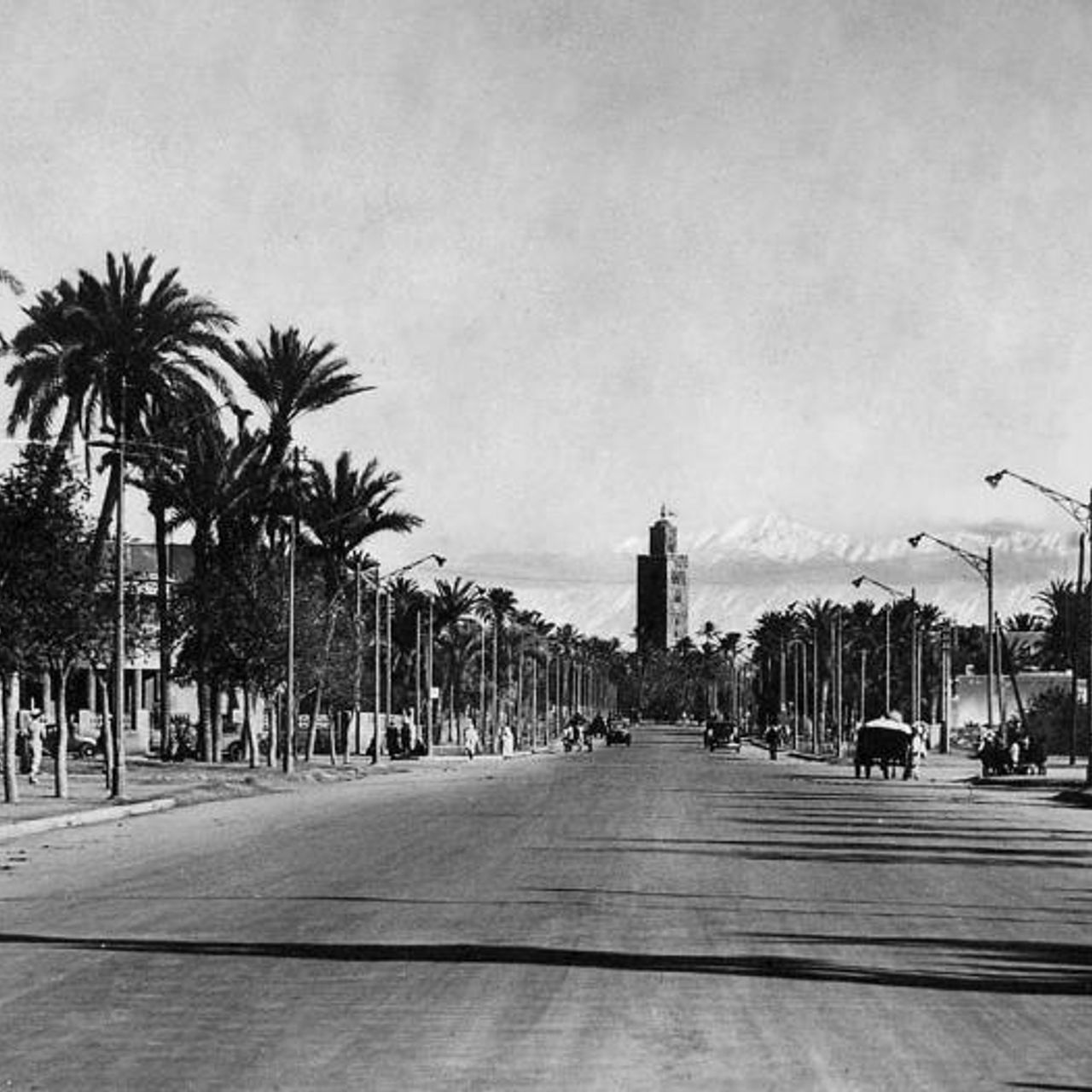
The district owes its name to Mount Jbel Guéliz
Everyone knows this large rock located to the northwest of Morocco, overlooking the city. Its dark schist gleams in the sun. It is said that the very illustrious Sidi-Bel-Abbès Es-Sebti began a long spiritual retreat there, which is why on the western flank of the rock there is a koubba where faithful still go on pilgrim. However, in 1912, during the occupation of the southern capital, the French troop commander was particularly struck by the mount's military vantage point. While respecting the pilgrimage path and the chapel, he established a citadel there from which cannons could monitor the city and thus any attempt at rebellion.

Architect Henri Prost designs and creates the district
In 1913, French architect Henri Prost was fully entrusted by Marshal Lyautey, governor of colonial Morocco, to establish a new city distinctly separate from the old one. To prevent uprisings, they chose to set up the new French camp at the foot of Mount Guéliz to have a clear view of the Medina from the heights. The new city quickly expanded and reached the gates of the Medina to create a unique city where one could move around easily.

A second Jemaa el Fna square
French architect Henri Prost, envisioned the new city in the image of the Medina. He constructed a sort of second Jemaa el Fna square from which wide avenues begin, and on which you find public buildings, residences, and shops. He named it "Place du 7 septembre," the date the French entered the ochre city in 1915 under the command of Colonel Mangin. The avenue connects directly to the Medina through the "Avenue du Guéliz," now known as "Avenue Mohamed V." The little sister of Jemaa el Fna square also changed its name in 1956, on the occasion of the return from exile of King Mohamed V, to become the present "Place du 16 novembre."

The ochre color was chosen purely for aesthetic reasons
Henri Prost was very sensitive to aesthetics and colors. He enjoyed the view offered by the setting sun on the Atlas and the Medina and especially its warm colors. To not lose these warm tones and this harmony in the natural landscape, he mandated that all new constructions not exceed three stories and that they have the ochre color.

In 1919, the Guéliz district had only 870 residents!
870, that's the tiny number of residents that the district had in 1919. While most were French, there were also many Moroccans (Muslims and Jews) but also Spaniards, Italians, Greeks, Syrians, and Senegalese. In reality, these numbers do not reflect the life in Guéliz at that time since they do not account for the families of the numerous officers, considered transient guests.
